“It’s not about the alcohol. It’s about sitting down with people and sharing culture and joy.”
If you ask young wine drinkers these days, you’ll hear this phrase – or variations of it – time and time again. Generation Z, born between 1997 and 2012, seems to be significantly changing the wine market. Not loudly, not revolutionarily. But consistently.
And in the midst of this quiet transformation, a wine is making a comeback that the wine world has long dismissed: Kalterersee from South Tyrol.
The generation that wants to do away with hangovers
The common narrative goes like this: Gen Z drinks less, and that’s a problem for the wine industry. The reality is more complicated – and ultimately more interesting.
A recent survey by IWSR (International Wine & Spirits Research), one of the leading market research institutes for alcoholic beverages, shows: The proportion of Gen Z adults (of legal drinking age) who drink has risen from 66 to 73 per cent between March 2023 and March 2025 – in the US, the figure has even risen from 46 to 70 per cent, and in the UK from 66 to 76 per cent. Anyone who broadly labels this generation as teetotallers is mistaken.
What has changed, however, is the ‘how’. Young consumers drink more consciously, in a more situational manner, and with higher expectations regarding quality and experience. Analyses of Vinitaly 2025 show that Millennials and Gen Z buy premium wines at a disproportionately high rate. Less frequently, but with greater discernment. More drinking culture, less volume – that is the real paradigm.
And it suits Lake Kaltern as well as a Vernatsch vine fits into the Pergel.
A wine with an image problem – and a great opportunity
Anyone who knows Lake Kaltern even a little also knows its fate. For decades, it was regarded as a mass-market product, hardly worth mentioning. Its reputation was not a good one.
Yet that image has changed fundamentally in recent years. The wein.kaltern initiative is driving the quality drive forward, and with the Kalterersee Anteprima – now in its third edition in 2026, at which 21 producers presented their vintage wines – Kaltern has established a format that is bringing the wine back into serious conversation. “It is important to us that the public can engage in conversation with the producers to learn more about their estates and their philosophy,” says Sighard Rainer, president of the wein.kaltern initiative.
At the 2025 South Tyrolean Vernatsch Cup, an international jury selected the finest examples of the grape variety from a field of 84 wines. Wine journalist Othmar Kiem’s verdict is clear: “Vernatsch is a traditional wine that is once again very much in vogue today. It impresses with its lightness and fruitiness. Particularly as a representative of the light-bodied reds category, it is becoming increasingly popular with young wine enthusiasts and sommeliers.”
Light-bodied reds. Chilled reds. These are the categories that are gaining momentum internationally – and Kalterersee is their South Tyrolean ambassador, a role it has always played, even before there was a name for it.
A glass that needs no explanation
What makes Kalterersee so perfect for this moment? First and foremost, it is simply what it is: a typical Vernatsch, made from the indigenous grape variety that the Romans found in the Rhaetian Alps – vernaculus, meaning ‘native’. DOC-certified, with its vineyards surrounding the eponymous lake in the Überetsch region of South Tyrol.
In the glass: a light, delicate ruby red. On the nose: red berries, cherry, sometimes a hint of violet. On the palate: light, fresh, with pleasant acidity and a gentle tannin structure. No muscle-flexer, no show-off. Not a wine that seeks to impress, but one that complements.
Depending on the producer and style, the alcohol content typically ranges between 11 and 12.5 per cent – at a time when the global average for red wines is steadily climbing towards 14 per cent. This is no coincidence. It is terroir.
And then there’s the distinctive feature that makes Kalterersee the perfect conversation starter: it’s drunk chilled. Chilled to around 14 to 16 degrees, it reveals its full freshness. A red wine that you chill – that’s the decisive ‘aha’ moment: the first step away from the intimidating ritual of serving wine and towards genuine accessibility. No complicated vocabulary, no decanting, no pondering over terroir profiles. Simply chill, pour, drink.
Authentic, Instagrammable and close by
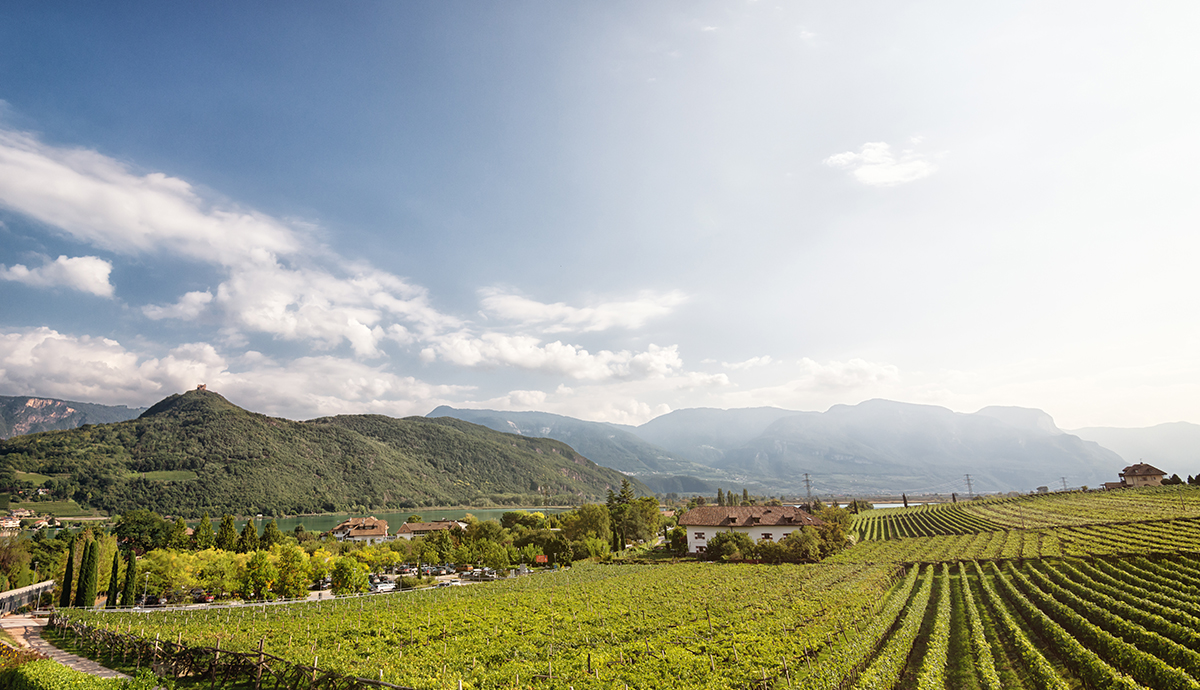
Lake Kaltern benefits from another advantage: the setting in which it is set. South Tyrol is no longer an insider’s tip for Gen Z – but neither is it a hackneyed postcard motif. The region offers what young travellers are looking for: a mountain backdrop and access to the lake, alpine heritage and an Italian-inspired laid-back atmosphere, sustainability thanks to short supply chains, and the authenticity of a wine culture where Vernatsch isn’t hidden away in the wine cellar but features on every village trattoria’s menu.
Lake Kaltern itself – with its vineyards behind it, its mild climate and lakeside terraces – is a natural backdrop that works on social media without looking staged. The characteristic ‘Pergel’ – the wooden vine arbours on which Vernatsch vines have been trained for centuries – shape the landscape like hardly any other symbol of Italian winemaking.
A heritage you can see and smell. For a generation that doesn’t compromise on authenticity, this isn’t a marketing promise – it’s a prerequisite.
Gen Z’s Beaujolais?
Is Lake Kaltern the Beaujolais Nouveau of the new generation of wines?
There are parallels. After years of struggling with a poor image, Beaujolais has, thanks to a Gamay renaissance, transformed itself into a style category that is now regarded as the epitome of an uncomplicated, light red wine – and has gained international recognition amongst young sommeliers.
Lake Kaltern could achieve something similar – with the advantage that it is even more affordable, its region of origin is more closely linked to a specific experience, and its drinking ritual – enjoying it chilled outdoors – is even more intuitive.
It already has what it needs for this: the product. What it needs even more is the narrative – precisely that story which explains why a wine dating back to the 12th century is the right choice for the 21st-century generation right now. Perhaps this story begins right here.